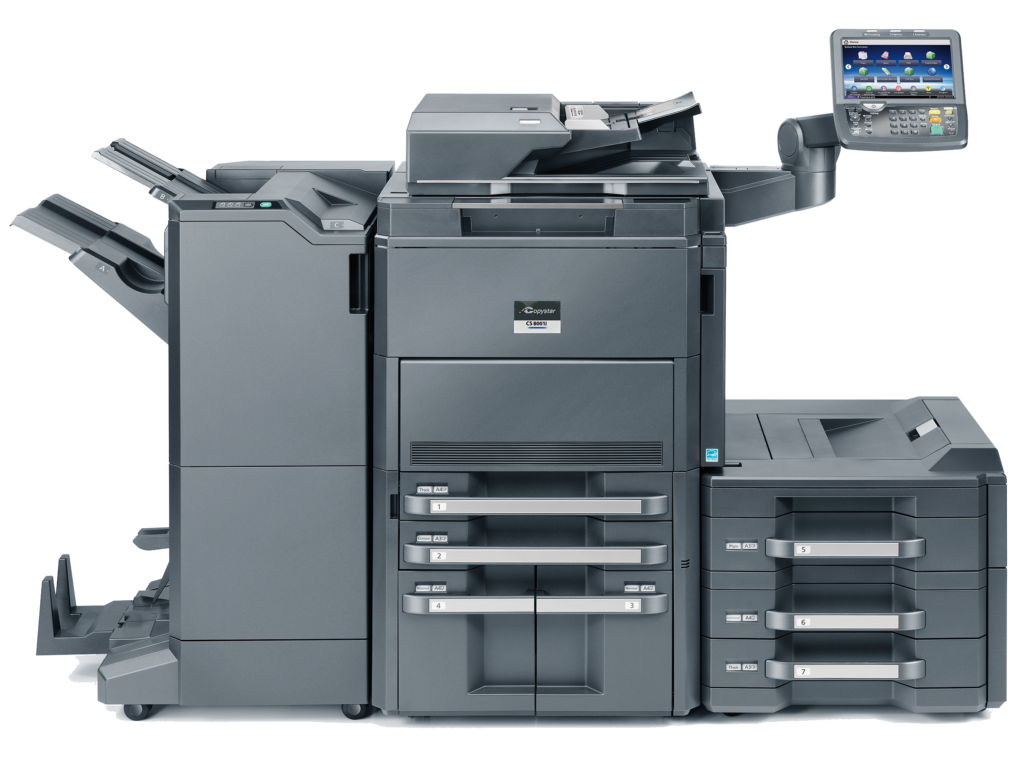
When analyzing cost-per-page for multifunction printers, you’ll need to look beyond the initial purchase price. Calculate your true costs by adding consumables (ink/toner), paper, electricity, and maintenance expenses. Laser printers typically cost 3-5 cents per page, while inkjets run 5-15 cents per page despite lower upfront costs. Your printing volume matters greatly—high-volume users benefit from laser printers’ efficiency, while occasional printers might do fine with inkjets. The right choice can save you thousands over your printer’s lifetime.
Expert Highlights
- Cost-per-page combines consumables, paper, electricity, and maintenance expenses to reveal a printer’s true operational cost.
- Laser printers typically cost 3-5 cents per page, while inkjets range from 5-15 cents per page.
- High-yield toner cartridges offer better long-term value despite higher upfront costs.
- Default settings for draft mode, duplex printing, and black-and-white can reduce costs by 15-40%.
- Duty cycle capacity affects long-term value, with laser models handling 3,000+ monthly pages versus inkjets’ 1,000.
Understanding the True Cost-Per-Page Calculation
The hidden reality of printer ownership lurks beneath the surface of advertised prices, often surprising businesses when the true operational costs emerge. When you’re calculating cost-per-page, you’ll need to look beyond the sticker price of your multifunction printer and consider several critical factors that impact your bottom line.
To determine your actual cost-per-page, divide the price of your consumables (toner cartridges, drums, maintenance kits) by their expected yield. For example, if a $100 toner cartridge produces 2,000 pages, your basic cost is 5 cents per page. Don’t forget to factor in paper costs ($0.01/page), electricity consumption ($0.001/page), and maintenance expenses (1-2 cents/page). By understanding these complete calculations, you’ll avoid the common pitfall of purchasing an affordable printer that drains your budget through excessive operational expenses.
Comparing Inkjet vs. Laser Printer Economics
When you’re comparing inkjet and laser printers, you’ll need to weigh the lower initial purchase cost of inkjets (typically $50-200) against the higher upfront investment for laser models ($200-500+). Your replacement supply expenses will differ greatly, with inkjet cartridges costing $20-60 but yielding only 200-600 pages, while laser toners might cost $60-200 but can produce 1,500-5,000 pages before needing replacement. For long-term usage value, you’ll find laser printers generally deliver better cost-per-page economics for high-volume printing (around 3-5 cents per page versus inkjets’ 5-15 cents), though inkjets remain economical for homes or small offices with occasional color printing needs.
Initial Purchase Costs
Two fundamental factors determine your printer investment: initial purchase price and long-term operational costs. When comparing multifunction printers, you’ll notice inkjet models typically cost $50-300, making them attractive for home or small office budgets. Laser printers demand a higher upfront investment of $200-800+ but often deliver long-term savings.
Your printing volume should guide this decision. If you’ll print fewer than 200 pages monthly, an inkjet’s lower entry price makes financial sense despite higher per-page costs. However, if you regularly produce 500+ pages monthly, a laser printer’s higher initial investment will pay dividends through considerably reduced operational expenses over its lifetime. Many organizations overlook this volume-based calculation, leading to unnecessary long-term spending that could have been avoided with more strategic initial purchasing decisions.
Replacement Supply Expenses
Although initial purchase prices provide a starting point for comparison, replacement supply expenses ultimately determine your printer’s true cost-per-page economics. You’ll find that inkjet printers typically require more frequent cartridge replacements, with costs ranging from $20-$45 per color cartridge while yielding only 200-500 pages. This translates to a cost-per-page of 3-15 cents, depending on your coverage and quality settings.
In contrast, laser printer toner cartridges cost more upfront ($60-$200), but they deliver 1,500-5,000 pages before replacement. Your per-page costs drop considerably to 1-5 cents. Many laser printers also separate toner from drums, allowing you to replace only what’s depleted. To maximize your supplies investment, consider high-yield cartridges, which offer lower cost-per-page despite higher initial prices.
Long-term Usage Value
Because initial purchase price and replacement costs tell only part of the story, you’ll need to evaluate your printer’s long-term usage value to make a truly informed decision. When you join the ranks of savvy printer owners, understanding the economics between inkjet and laser technologies becomes essential for maximizing your investment.
Consider these long-term value factors when comparing options:
- Duty cycle capacity – laser printers typically handle 3,000+ pages monthly versus inkjet’s 1,000, affecting device lifespan
- Energy consumption – inkjets use 30-50 watts during operation while lasers require 300-550 watts
- Maintenance requirements – inkjets need regular head cleanings that consume ink, while lasers need occasional drum replacements
- Paper handling capabilities – lasers offer more consistent performance with various paper weights, reducing waste from reprints
These elements greatly impact your total ownership costs beyond the advertised price per page.
How Print Volume Affects Your Bottom Line
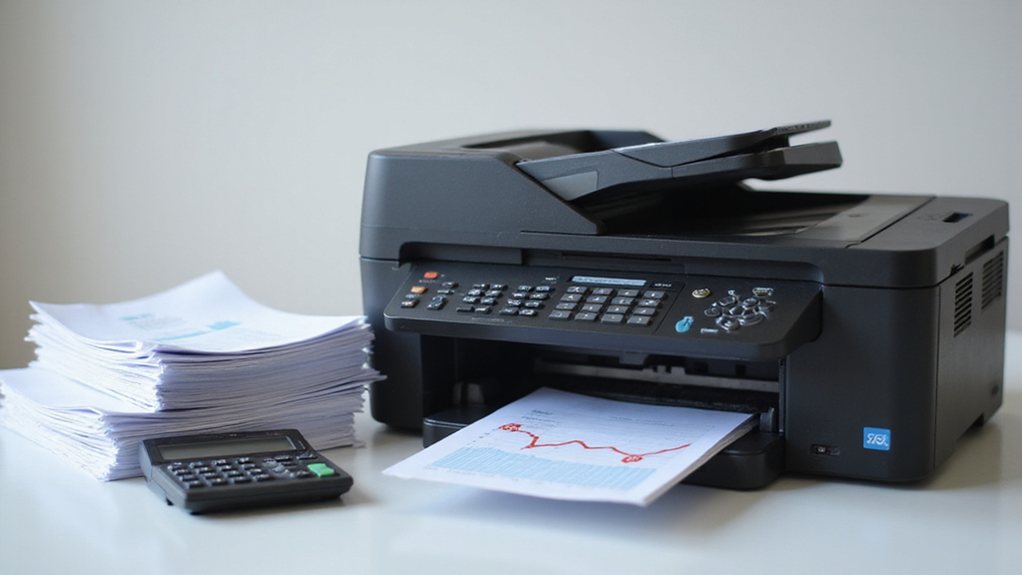
Print volume stands as the single most influential factor affecting your multifunction printer‘s cost-per-page calculation. When you’re printing in low volumes, the per-page cost skyrockets because you’re spreading fewer pages across your fixed costs. Conversely, high-volume printing environments benefit from economies of scale, dramatically reducing your cost-per-page.
| Monthly Volume | Small Office | Medium Business | Enterprise |
|---|---|---|---|
| Under 1,000 | $0.12-0.15 | $0.10-0.12 | Inefficient |
| 1,000-3,000 | $0.08-0.10 | $0.06-0.08 | $0.05-0.06 |
| 3,000-10,000 | $0.06-0.07 | $0.04-0.05 | $0.03-0.04 |
| Over 10,000 | Inefficient | $0.03-0.04 | $0.02-0.03 |
You’ll need to accurately assess your organization’s print requirements before purchasing. Underestimating leads to higher operational costs, while overestimating means you’ve invested in unnecessary capacity, tying up capital that could serve your team elsewhere.
Hidden Costs Beyond Ink and Toner
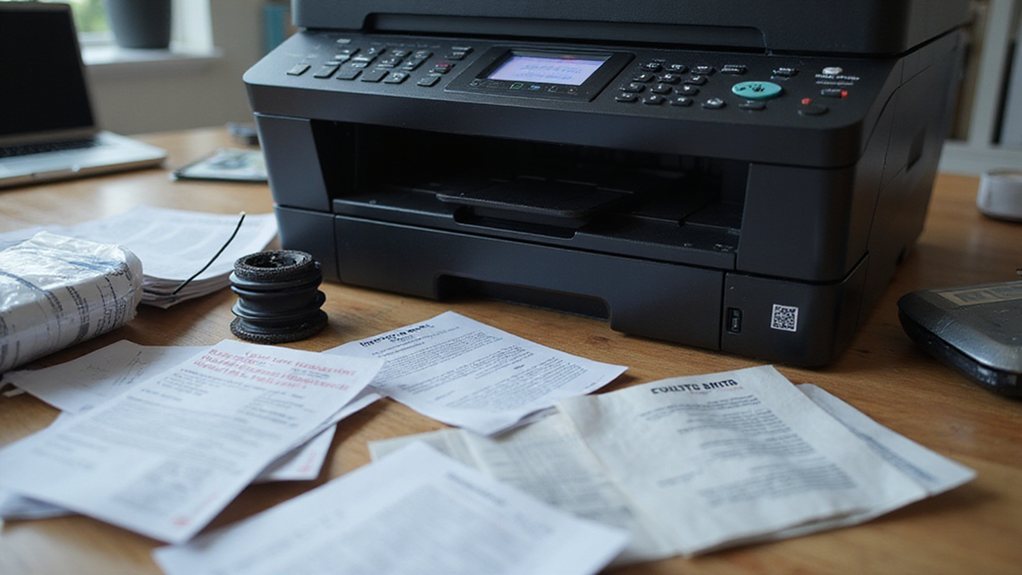
You’re likely overlooking two significant expenses when calculating your multifunction printer’s true cost-per-page: maintenance package costs and depreciation over time. Maintenance agreements, which typically range from $100-$300 annually, provide essential service coverage but add approximately 0.2-0.5 cents per page to your overall printing costs. Your printer’s value will steadily decline at 20-30% per year, affecting both your balance sheet and the eventual replacement timeline, which means today’s $1,000 office printer could be worth just $343 after three years.
Maintenance Package Costs
While most buyers focus exclusively on the upfront cost of a multifunction printer and its consumables, maintenance package expenses often lurk beneath the surface, greatly impacting your total cost of ownership. You’ll find these packages vary considerably across manufacturers, with some offering thorough coverage while others nickel-and-dime you for every service call.
When evaluating maintenance packages, consider these critical elements:
- Annual service contract costs as a percentage of your initial purchase price
- Coverage limitations for parts that typically fail after extended use
- Response time guarantees and their impact on your workflow
- Escalating costs in years 3-5 when components are more likely to fail
Depreciation Over Time
Unlike consumables that visibly drain your budget with each print job, printer depreciation silently erodes your investment daily, whether the machine sits idle or runs continuously. Most businesses overlook this substantial cost factor when calculating their true cost-per-page.
Your multifunction printer typically loses 20-30% of its value in the first year alone, with high-end models depreciating even faster as newer technology emerges. To minimize this hidden expense, consider leasing options that shift depreciation risk to the provider, or select models with proven longevity and strong resale values. When you’re evaluating equipment, look beyond the initial price tag and factor in 3-5 year depreciation rates. Many printer manufacturers now publish expected lifetime values, helping your team make informed decisions that protect your investment against rapid technological obsolescence.
Case Studies: Small Business vs. Enterprise Printing Expenses
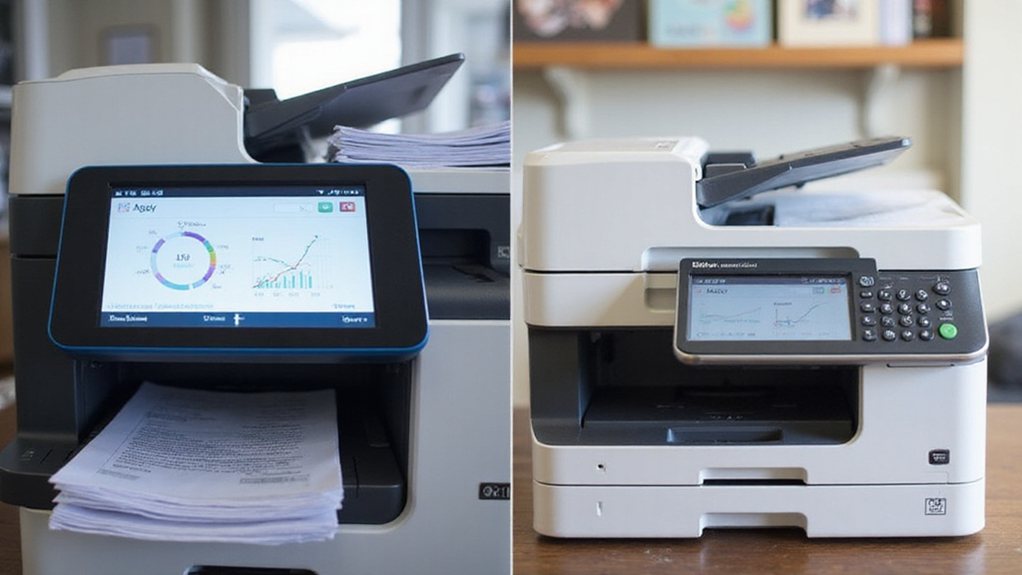
To understand the real-world impact of printing costs, examining actual case studies from both small businesses and large enterprises reveals striking differences in their printing expenses. When you compare these organizations, you’ll notice distinct patterns in how printing costs affect their bottom lines.
- Small businesses typically spend 1-3% of annual revenue on printing, with an average cost of $0.08-$0.15 per page when using mid-range multifunction devices
- Enterprise organizations achieve economies of scale, reducing per-page costs to $0.04-$0.06 through volume contracts and dedicated print management
- Service-based small businesses face higher relative costs due to client documentation requirements, often exceeding $3,000 annually per employee
- Manufacturing enterprises leverage centralized printing hubs that decrease costs by 40% compared to distributed printing stations among departments
Strategies to Reduce Your Cost-Per-Page
When your organization faces rising printing costs, implementing targeted strategies can greatly reduce your cost-per-page without sacrificing quality or efficiency. Start by configuring default settings to print in draft mode, duplex (double-sided), and black-and-white for internal documents. These simple changes can cut your costs by 15-40% immediately.
Next, consider investing in print management software that tracks usage patterns, allocates costs to departments, and identifies wasteful practices. You’ll join thousands of businesses that have reduced their printing expenses by 20-30% through enhanced visibility.
Finally, negotiate better contracts with suppliers that include volume discounts and fixed cost-per-page agreements. Many organizations find that consolidating multiple devices into fewer, more efficient multifunction printers considerably lowers their total cost of ownership while improving productivity across teams.
Recent Technological Advances Impacting Printing Economics
The printing industry has undergone remarkable technological transformation in recent years, reshaping the economics of document production for businesses of all sizes. You’ll find these innovations directly impact your bottom line through reduced cost-per-page metrics.
Cutting-edge print technology delivers measurable cost savings for businesses through dramatically improved cost-per-page economics.
- Ink subscription services now allow you to pay monthly for ink delivery based on your actual usage, eliminating large upfront cartridge expenses
- High-yield toner formulations extend cartridge life up to 10,000 pages, reducing your per-page costs by nearly 40%
- Smart monitoring systems analyze your printing patterns and automatically adjust settings to minimize waste
- Advanced printhead technology increases efficiency while reducing maintenance needs, cutting both direct costs and downtime
These developments aren’t just technical improvements—they’re practical solutions to the rising costs you’ve faced with traditional printing methods. By adopting these technologies, you’ll join forward-thinking organizations enjoying substantial savings.
Frequently Asked Questions
How Does Paper Quality Affect Cost-Per-Page Calculations?
Paper quality directly impacts your cost-per-page. Premium papers cost more, increasing your per-page expense. You’ll also find that higher-quality paper often requires more ink to prevent bleeding and enhance print quality.
Can Refurbished Printers Deliver Comparable Cost-Per-Page to New Models?
Yes, you’ll find refurbished printers often deliver comparable cost-per-page to new models, especially when they’re professionally reconditioned with genuine parts and come with warranties from reputable sellers.
How Do Environmental Conditions Impact Printer Efficiency and Costs?
Environmental conditions greatly impact your printer’s efficiency. Extreme humidity can cause paper jams, while dust accumulation increases maintenance costs. You’ll save money by keeping your printer in a clean, temperature-controlled space.
What Printer Maintenance Tasks Can Users Perform Themselves?
You can clean print heads, replace cartridges, clear paper jams, wipe exterior surfaces, and run maintenance utilities. Don’t forget to keep your paper tray stocked with quality paper.
How Do Wireless Printing Features Affect Overall Cost-Per-Page?
Wireless printing doesn’t directly impact your cost-per-page. You’ll pay the same for ink and paper, but you’re gaining convenience and flexibility that connects you to your printing community wirelessly.
Expert Final Thoughts
You’ve now seen that cost-per-page extends far beyond the sticker price of your multifunction printer. By calculating your actual printing needs, comparing inkjet versus laser technologies, and accounting for those hidden maintenance expenses, you’ll make smarter investments. Remember to reassess as your print volume changes and implement the suggested reduction strategies. With these insights, you’ll not only cut costs substantially but also make environmentally responsible choices that benefit your bottom line.